
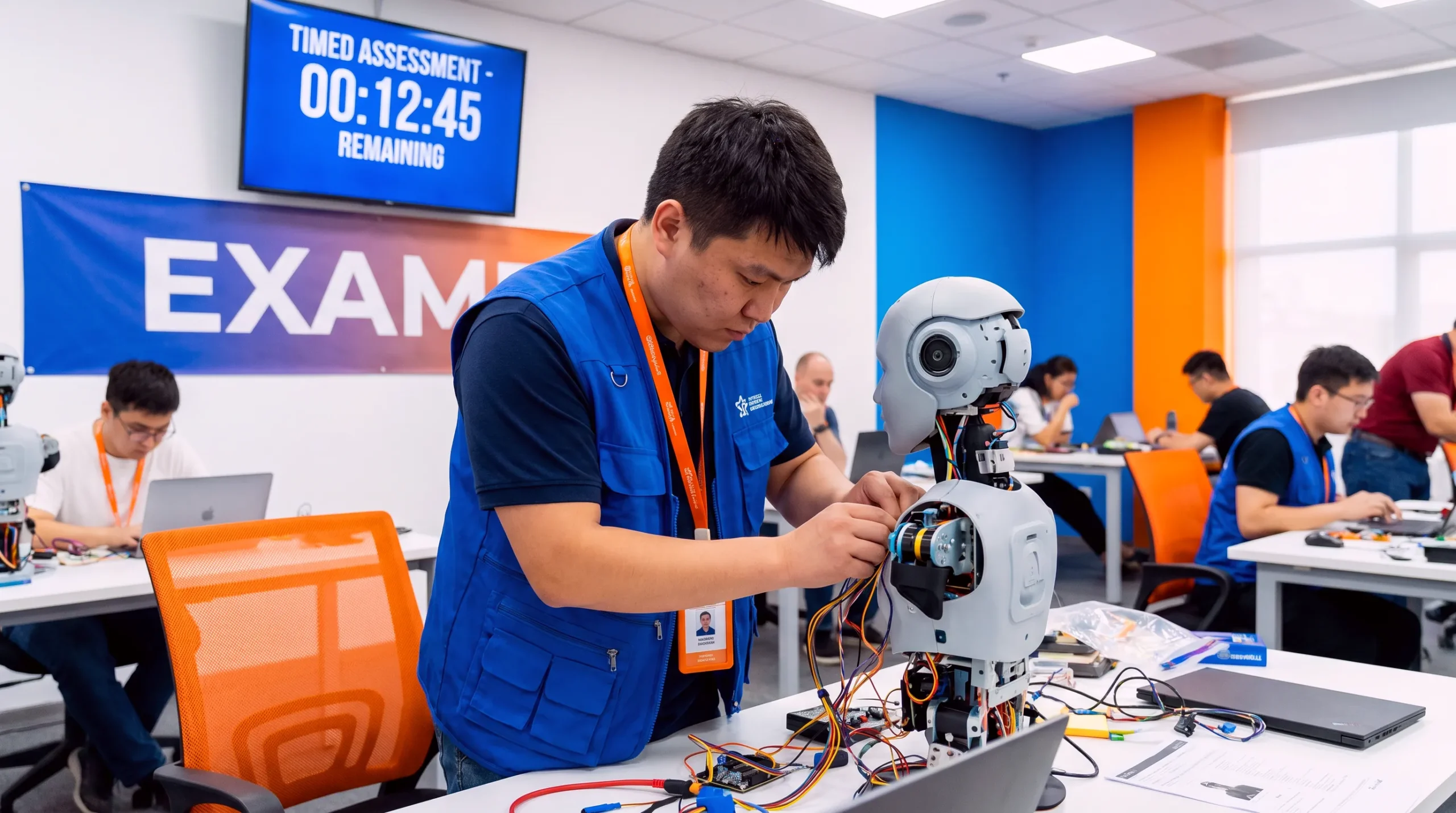
Anthropic has expanded its Claude certification programme into a set of four role-based credentials. For anyone building a practice around Claude, or working with a firm that does, these are worth understanding properly rather than at headline level. This post breaks down what each certification is, who it is for, how the exams are structured, and how to prepare, drawn directly from the official exam guides.
There are now four certifications, spanning two levels:
| Certification | Code | Level | Fee (USD) | Items | Time |
|---|---|---|---|---|---|
| Claude Certified Associate – Foundations | CCAO-F | Foundations | $99 | 60 | 120 min |
| Claude Certified Developer – Foundations | CCDV-F | Foundations | $125 | 53 | 120 min |
| Claude Certified Architect – Foundations | CCAR-F | Foundations | $125 | 60 | 120 min |
| Claude Certified Architect – Professional | CCAR-P | Professional | $175 | 63 | 120 min |
All four are proctored exams delivered through Pearson VUE, online or at a test centre. All use a scaled score of 100 to 1,000 with a cut score of 720 to pass. All credentials are valid for 12 months.
The exams sit behind the Claude Partner Network: exam access runs through a partner organisation, though the preparation courses on Anthropic’s Academy are free and open to anyone with an email address.
The four credentials map to three roles, at two levels of depth.
The Associate credential is the only non-technical one. It is aimed at people who use Claude as a productivity tool rather than people who build with it. The Developer and Architect – Foundations credentials both assume real engineering experience. The Architect – Professional credential sits above Foundations, aimed at senior practitioners leading enterprise delivery.
A sensible way to read the stack: Associate is the entry point for delivery and knowledge-work roles; Developer and Architect – Foundations are parallel technical credentials for people who already build with Claude; Architect – Professional is the step up for those designing and governing production systems end to end.
There are no mandatory prerequisites for any of the four. Each credential is awarded on exam performance alone. The recommended experience below is guidance, not a gate.
Who it is for. Professionals who use Claude as a productivity tool in roles such as operations, marketing, project management, education, and communications. It covers using built-in platform features to streamline work, spotting where Claude can improve a process, balancing quality against cost and effort, and knowing when to escalate more technical work to a Developer or Architect.
This is explicitly not aimed at software developers or people designing agentic systems. It sits between the casual prompt user and the technical practitioner.
Recommended experience. Regular hands-on use of Claude in a professional setting, a grasp of structured problem-solving and workflow design, and a practical understanding of AI limitations such as hallucination, context limits, and data sensitivity. No development or API experience is needed.
Exam. 60 items, 120 minutes, $99.
What it tests (domain weights):
| Domain | Weight |
|---|---|
| Output Evaluation and Validation | 21% |
| Workflow Integration and Solution Design | 16% |
| Governance, Risk, and Responsible Use | 15% |
| Prompting and Task Execution | 14% |
| Product and Model Selection | 12% |
| Configuration and Knowledge Management | 12% |
| Troubleshooting and Optimisation | 10% |
The largest single area is evaluating and validating Claude’s output: checking for accuracy, spotting hallucinations and bias, fact-checking, and deciding when human review is required. Governance and responsible use is weighted heavily too, covering data sensitivity, privacy, and appropriate versus inappropriate use cases.
Who it is for. Engineers who build, integrate, and ship production applications, agents, and workflows on Claude. It covers building agents with the Claude Agent SDK, integrating Claude through the API and client SDKs, operating Claude Code, prompt and context engineering, evaluation, model selection, security, and building custom tools and MCP servers.
Recommended experience. One to five years in software engineering, at least six months hands-on with Claude or comparable LLM systems, proficiency in Python or TypeScript, fluency with REST APIs and CLI tools, and a working understanding of LLM fundamentals, agents, context management, and MCP.
Exam. 53 items, 120 minutes, $125.
What it tests (domain weights):
| Domain | Weight |
|---|---|
| Applications and Integration | 33.1% |
| Model Selection and Optimisation | 16.8% |
| Agents and Workflows | 14.7% |
| Prompt and Context Engineering | 11.0% |
| Tools and MCPs | 10.6% |
| Security and Safety | 8.1% |
| Claude Code | 3.1% |
| Eval, Testing, and Debugging | 2.6% |
The exam is weighted firmly toward applications and integration: API mechanics, software engineering foundations, application design across interfaces, and configuration management make up a third of it. Model selection and cost or token optimisation is the next largest area.
Who it is for. Solution architects who design and implement production applications with Claude. It assumes hands-on experience building agentic applications with the Agent SDK, configuring Claude Code for team workflows, designing MCP tool and resource interfaces, engineering prompts for reliable structured output, managing context across long interactions, and integrating Claude into CI/CD pipelines.
Recommended experience. Six or more months building with the Claude API, Agent SDK, Claude Code, and MCP, with a working understanding of both the capabilities and the limits of LLMs in production.
Exam. 60 items, 120 minutes, $125. This is the one scenario-based exam of the four: it presents four scenarios drawn at random from a bank of six, each framing a set of questions around a realistic production context (a customer support agent, a multi-agent research system, Claude Code in CI/CD, structured data extraction, and so on).
What it tests (domain weights):
| Domain | Weight |
|---|---|
| Agentic Architecture and Orchestration | 27% |
| Claude Code Configuration and Workflows | 20% |
| Prompt Engineering and Structured Output | 20% |
| Tool Design and MCP Integration | 18% |
| Context Management and Reliability | 15% |
Agentic architecture is the heaviest domain: agentic loops, coordinator-subagent patterns, task decomposition, and enforcement and handoff patterns. The exam rewards practical judgement about architecture and tradeoffs, not definitions.
Who it is for. Mid to senior technical professionals who design, build, and deliver production-grade Claude solutions and lead the decisions around them. Beyond the Foundations material, it adds retrieval-augmented generation, observability at scale, compliance with regulations such as GDPR and HIPAA, and the stakeholder and lifecycle side of delivery: discovery, communicating architectural tradeoffs, and managing expectations and SLAs.
Recommended experience. Three or more years in systems architecture or platform engineering, six or more months with Claude in production, and experience delivering end-to-end systems from discovery through operation.
Exam. 63 items, 120 minutes, $175.
What it tests (domain weights):
| Domain | Weight |
|---|---|
| Integration | 19% |
| Solution Design and Architecture | 17% |
| Evaluation, Testing, and Optimisation | 16% |
| Governance, Safety, and Risk Management | 14% |
| Stakeholder Communication and Lifecycle Management | 14% |
| Claude Models, Prompting, and Context Engineering | 13% |
| Developer Productivity and Operational Enablement | 7% |
The weighting is noticeably flatter than Foundations. It spreads across integration, solution design, evaluation, governance, and stakeholder management, which reflects the breadth expected of someone owning a solution end to end rather than a single build.
Every exam guide says the same thing about preparation: there is no single required course, and no resource guarantees a pass. The route that works is self-study against the published blueprint plus genuine hands-on practice.
Three steps apply across all four:
Anthropic’s Academy hosts self-paced courses that map onto the exam domains. They are free, need only an email to enrol, and award a completion certificate that is separate from the exam credential. The full catalogue is at anthropic.skilljar.com, and Anthropic’s wider learning hub is at anthropic.com/learn.
Anthropic has not yet published a course-to-certification mapping of its own. The matrix below is our content-based mapping of the Academy catalogue against each certification’s published exam domains. The markers mean: Foundation where a course builds baseline knowledge for that cert’s domains, Advanced where it covers them at production or deep-dive depth, and blank where it does not apply. Study times are the Academy’s own estimates.
| Course | CCAO-F | CCDV-F | CCAR-F | CCAR-P | Study time |
|---|---|---|---|---|---|
| Claude 101 | Foundation | ||||
| Claude Code 101 | Foundation | Foundation | 1.5 hrs | ||
| Claude Platform 101 | Foundation | ||||
| Introduction to Claude Cowork | Foundation | 0.5 hrs | |||
| Claude Code in Action | Advanced | Advanced | Foundation | 1 hr | |
| AI Fluency: Framework and Foundations | Foundation | 1.1 hrs | |||
| AI Capabilities and Limitations | Foundation | Foundation | Foundation | Foundation | 0.25 hrs |
| Building with the Claude API | Advanced | Advanced | Foundation | 8.1 hrs | |
| Introduction to Model Context Protocol | Advanced | Foundation | Foundation | 1 hr | |
| MCP: Advanced Topics | Advanced | Advanced | Foundation | 1.1 hrs | |
| Introduction to Agent Skills | Foundation | Foundation | |||
| Introduction to Subagents | Foundation | Foundation | |||
| Claude with Amazon Bedrock | Advanced | Foundation | Foundation | 8 hrs | |
| Claude with Google Cloud’s Vertex AI | Advanced | Foundation | Foundation | 8 hrs | |
| AI Fluency for Educators | Foundation | 0.4 hrs | |||
| AI Fluency for Students | Foundation | 0.5 hrs | |||
| Teaching AI Fluency | Foundation | 0.6 hrs | |||
| AI Fluency for Nonprofits | Foundation | 0.9 hrs | |||
| AI Fluency for Small Businesses | Foundation | 0.9 hrs | |||
| AI Fluency for Builders | Foundation | 1 hr |
Two gaps are worth naming. The Associate exam weights governance and responsible use at 15 percent, but no Academy course treats AI governance or risk as its main subject; it is only touched on within the AI Fluency diligence material. The Architect – Professional exam is the least well served by the catalogue: nothing currently covers its governance, safety and risk domain (including GDPR and HIPAA) or its stakeholder communication and lifecycle domain, which is why the cloud and API courses map to it only at Foundation depth. Both of those domains lean on real delivery experience more than on any course.
Not part of the Academy catalogue, and not officially mapped to any exam, but useful practice material for the technical credentials:
| Resource | CCAO-F | CCDV-F | CCAR-F | CCAR-P |
|---|---|---|---|---|
| Claude Code: A Highly Agentic Coding Assistant (DeepLearning.AI) | Foundation | Foundation | ||
| MCP: Build Rich-Context AI Apps (DeepLearning.AI) | Foundation | Foundation | ||
| Agent Skills with Anthropic (DeepLearning.AI) | Foundation | Foundation | ||
| anthropics/courses on GitHub (API fundamentals, prompt engineering, real-world prompting, prompt evaluations, tool use) | Foundation | Foundation | Foundation | Foundation |
To reach the exam itself, registration runs through the Anthropic Partner Academy: anthropic-partners.skilljar.com/page/partner-certifications.
A few things worth knowing before booking any of the four:
nThe details in this post are drawn from the official Anthropic exam guides, version 1.0, effective July 2026. Fees, formats, and availability can change; confirm current details on the Anthropic Partner Academy before booking.
To provide the best experiences, we use technologies like cookies to store and/or access device information. Not consenting or withdrawing consent, may adversely affect certain features and functions.